







Twenty Ninth Sunday in Ordinary Time
October 18, 2026
REFLECTION ON TODAY'S READING
Giving Each Thing Its Rightful Place
On this new day, pause to give thanks to the Lord and open your heart to listen to His Word. The Lord invites you to engage in true discernment: “Render to Caesar the things that are Caesar’s, and to God the things that are God’s” (Mt 22:21).
Ask Him to teach you to put everything in its rightful place, to give Him first priority in your life, with all your heart, your faith, and your love. Ask Him, too, to help you be faithful in your daily responsibilities, with honesty and integrity.
Ask yourself before the Lord: Do you truly entrust your life to Him? Give Him your desire to follow Him and ask Him to help you grow a unified heart.
Offer this day to the Lord through the daily offering.
Under the directive from the Diocese of Honolulu
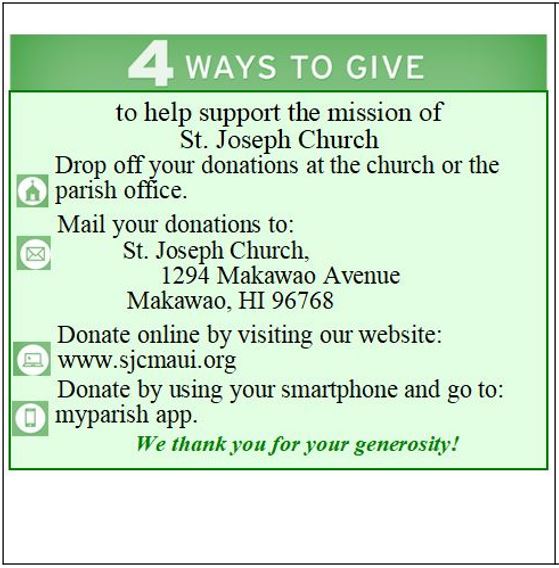
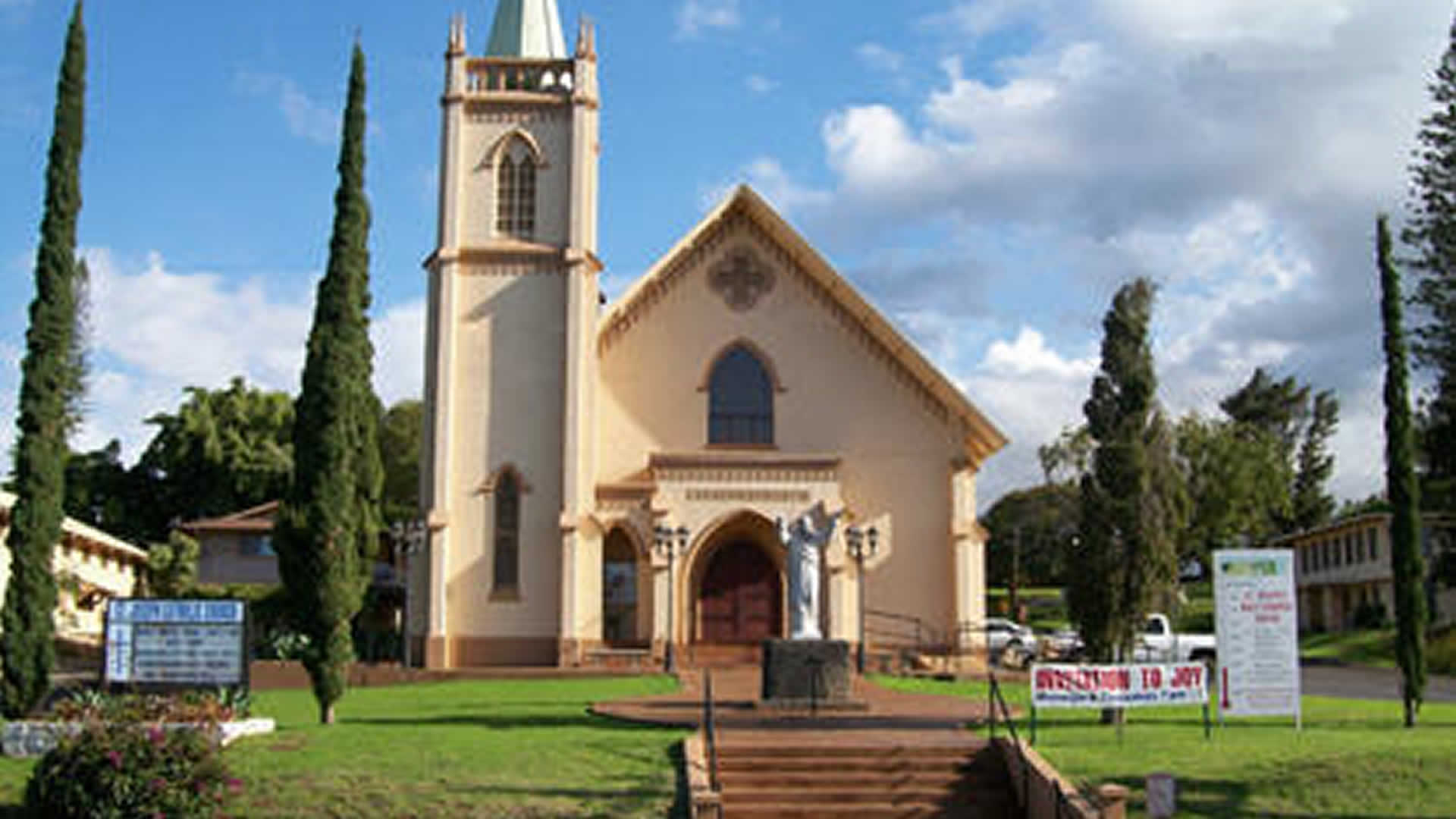
St. Joseph Church has set up an egiving program to allow parishioners and guests an easier way to give. It will also allow the donors to: 1. Give from anywhere using a computer, tablet, or smartphone. 2. No need to find a check or stop by the ATM. 3. Use your Checking/Savings Account or your Debit/Credit Card. 4. Schedule gifts to occur automatically. Click on the give now link or on your phone using my parish app. “All must give as they are able, according to the blessings given to them by the Lord your God.” Deuteronomy 16:17
Online donations may be made at any time from the comfort of your own home or any place with internet access. Online donations are credited to your tax statement for the end of the year (except when made anonymously)and you can change your account preferences and donation amounts at any time..

Saint Joseph Church Makawao - Bulletin



The Gospel Reading, Matthew 22:15-21
The Pharisees send their disciples to test Jesus with a question about taxes.
In today’s Gospel Jesus and the religious leaders in Jerusalem continue their tense exchange of questions and challenges. At this point the disciples of the Pharisees, together with the Herodians, try to entrap Jesus by their question about the payment of taxes.
Matthew sets up an unusual partnership between the Pharisees and the Herodians. The Herodians were supporters of Herod Antipas, a Jewish political leader who collaborated with the Romans. Such collaboration would have required a compromised observance of the Mosaic Law. The Pharisees, on the other hand, taught scrupulous observance of the Mosaic Law and opposed Roman occupation. Herodians favored the payment of taxes; the Pharisees opposed it. The Herodians and the Pharisees approach Jesus, asking that he take sides in their dispute. If Jesus answers with the Pharisees, he shows himself to be an enemy of Rome. If he answers with the Herodians, he offends popular Jewish religious sensibilities.
Jesus’ response to this attempt to trap him exposes the guile of his questioners. From his first words to them, Jesus shows that he is very much aware of what they are trying to do. He asks to see a Roman coin, which is readily provided to him. It may have come from the hand of a Herodian, but the Pharisees show themselves to be quite willing to accept this compromise. Jesus has already exposed the Pharisees as hypocrites.
Jesus takes his response one step further. He asks that his questioners examine the coin. Agreeing that it is Caesar’s image on the coin, Jesus tells them that it must belong to Caesar. Avoiding the question of lawfulness altogether, Jesus answers their question with simple logic. Then, going further still, Jesus tells them that their obligation is to pay to God that which belongs to God.
Jesus’ response to the Herodians and Pharisees suggests the ethic that Christians ought to adopt. It reminds us of the importance of keeping things in their proper perspective. Do we attach ourselves to worldly things at the expense of the love and honor that we owe to God?.
—
(https://www.loyolapress.com/catholic-resources/liturgical-year/sunday-connection )
.
A STEWARDSHIP MOMENT
Jesus offers us a profound teaching on stewardship in this weekend’s reading: What belongs to Caesar? What belongs to God? Christian stewards recognize that everything they have belongs to God. God created them, and God has claims on every part of their existence. They also realize that the sovereign is an institution whose nature and purpose is to promote the common good and protect the welfare of its xcitizenry. As long as it accomplishes this mission while treating every single person with deep respect, justice and compassion, it merits the steward’s support and cooperation. Christian stewards know what belongs to the Lord, and they are better citizens when they live their lives according to his Gospel.
—— (https://catholicstewardship.com/)
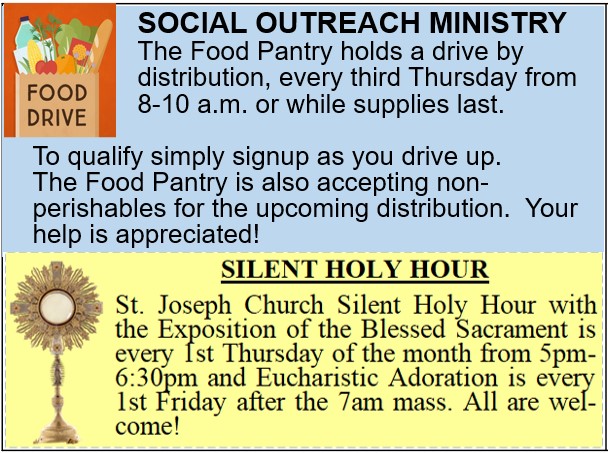
EUCHARISTIC ADORATION OF THE BLESSED SACRAMENT
First Thursday of Every Month. Come anytime between 5-6:30 pm.. All are Welcome!
THRIFT SHOP HOURS OF OPERATION
Open on Tuesdays and 1st, 2nd and 3rd Saturday of the month 8am-12 noon. Receiving donations every Monday from 8 - 10 a.m., or during normal thrift shop hours.